AI + Low-Code + Automation: The Enterprise Architecture Behind Scalable Digital Transformation

Over the last few years, enterprise technology leaders have experienced an unprecedented wave of innovation. Low-code platforms have accelerated application development, generative AI has unlocked new forms of decision intelligence, and automation technologies are redefining how work is executed across organizations. In many ways, we are living in the era of instant innovation.
Yet despite the explosion of tools and platforms, many organizations still struggle to turn these technologies into measurable business outcomes. Most enterprises are experimenting. Only a few are transforming.
The Paradox of Modern Enterprise Innovation
Across industries, organizations are running pilots for AI assistants, building low-code applications, and automating specific tasks. But many of these initiatives remain isolated. A team launches an AI pilot. Another group builds a low-code workflow. Operations deploy a few automation bots. Individually each initiative shows promise, but collectively they rarely change how the business operates.
This happens because experimentation alone does not scale. Without structure, governance, and repeatable architecture, pilots become technology experiments rather than enterprise capabilities.
Moving Beyond Pilots: The Shift Toward Productized Digital Platforms
Organizations realizing meaningful value from AI and automation are approaching the problem differently. Instead of launching one-off technology projects, they are building productized digital platforms—repeatable solutions designed for operational impact.
These platforms combine several capabilities: analytics that generates insights, applications that embed those insights into operational workflows, AI that augments decisions, and automation that orchestrates execution.
Why Low-Code Is Becoming the Backbone of Enterprise Innovation
Low-code platforms have matured significantly in recent years. Applications that once took months to build can now be delivered in weeks, allowing organizations to respond faster to business needs and iterate continuously.
However, speed alone is not enough. Without governance and integration with enterprise data platforms, low-code initiatives can become fragmented. Successful organizations treat low-code platforms as part of a larger digital architecture.
Embedding AI into Operational Workflows
Artificial intelligence is rapidly moving from experimentation into operational systems. Early AI initiatives focused on standalone capabilities such as chatbots or predictive models. Today, the real value emerges when AI is embedded directly into workflows.
AI systems can prioritize service cases, detect operational risks, and assist employees with contextual knowledge. But these systems must operate within governed environments that include monitoring, data governance, and security controls.
Automation as the Orchestration Layer
Automation is evolving beyond simple task automation. Modern automation platforms orchestrate complex processes across systems, connecting data flows, decision logic, human approvals, and system integrations.
When automation connects insights with execution, organizations begin to see measurable improvements in efficiency, cycle time reduction, and operational resilience.
The VNB Autonomous Enterprise Framework
Modern enterprise transformation can be understood through four connected capabilities: Analytics, Apps, AI (Agentic AI) and Automation. Together these layers create a closed loop between insight, decision, and action.
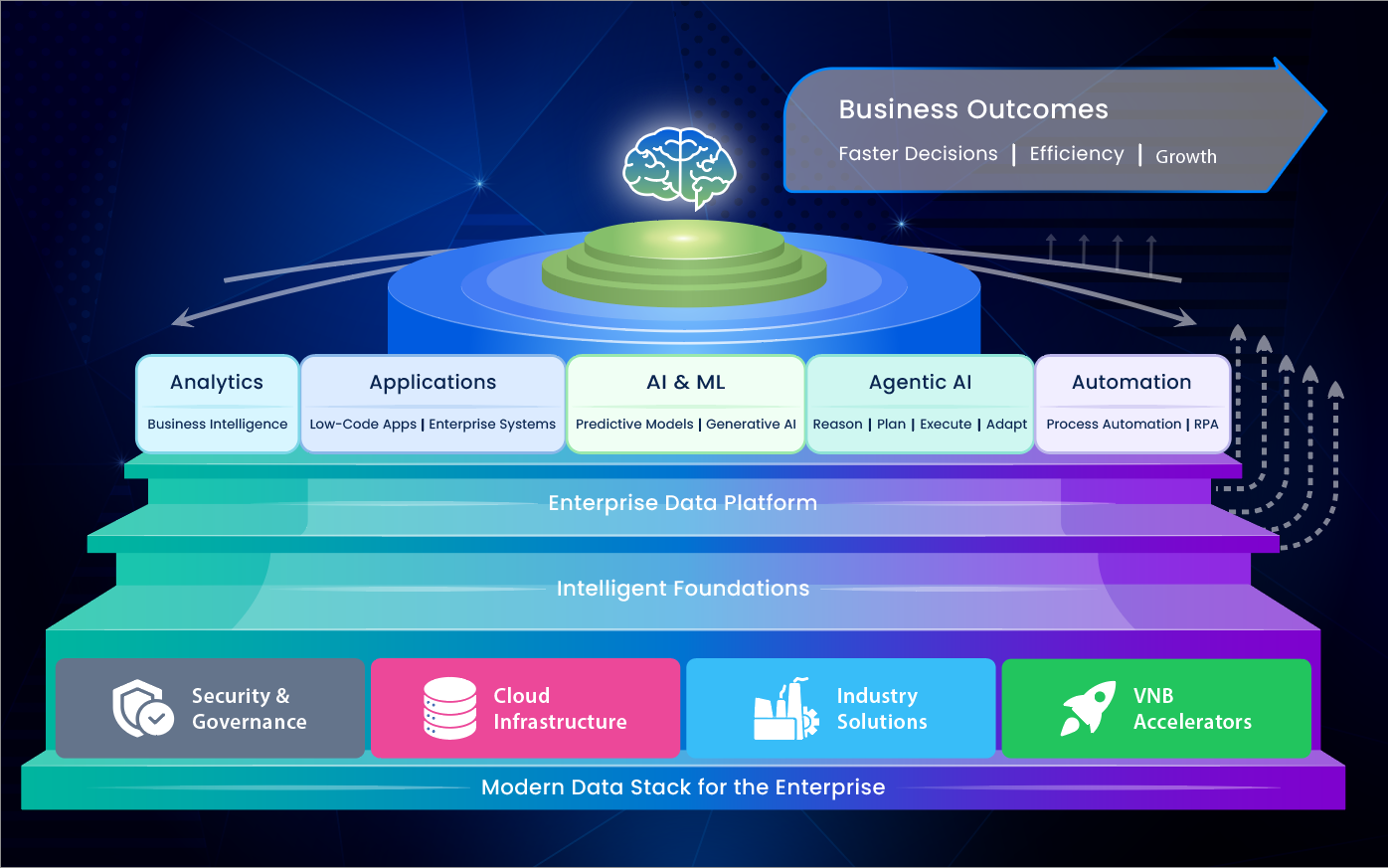
Analytics provide the data foundation and insight layer. Applications embed workflows and user interaction. Artificial intelligence augments decision-making through prediction and contextual reasoning. Agentic AI systems reason, plan, execute and adapt and coordinate applications, automation workflows and analytics signals. Automation executes actions across systems and processes.
Some examples of Agent roles are:
Operations Agent
Monitors KPIs and triggers workflows.
Customer Agent
Handles service interactions autonomously.
Finance Agent
Reconciles data and flags anomalies.
Healthcare Agent
Coordinates patient workflows.
This is what transforms systems into AI-driven enterprises.
From Digital Experiments to Digital Operating Models
Many organizations today are still in the phase of experimenting with digital technologies. Becoming a truly digital enterprise requires building systems that deliver repeatable outcomes, scale across the organization, and continuously improve through data.
The future of enterprise technology will not be defined by who experiments with new tools. It will be defined by who builds scalable systems that translate technology into measurable business advantage.
If your organization is exploring how to operationalize AI, low-code platforms, and automation at scale, connect with our team to discuss how the 4A architecture can support your transformation journey.
Content Credits: DPS Bali