FabCon 2026: What Microsoft Fabric’s Biggest Announcements Mean for Your Data Strategy
The Microsoft Fabric Community Conference (FabCon) 2026, co-located with SQLCon for the first time, brought together over 8000 data professionals. This event marked a significant development in Microsoft’s strategy, as Fabric is now positioned not only as an analytics suite but also as a unified control plane encompassing databases, OneLake, governance, and agentic capabilities that enable modern data teams to streamline their data and analytics infrastructure.
With more than 31,000 customers already on the platform, Microsoft Fabric has emerged as one of the fastest-growing data platforms in Microsoft’s history. This growth reflects robust enterprise trust and a maturing ecosystem, offering strong support for organizations evaluating Fabric for their data needs.
Data Agents and Fabric IQ Redefine Intelligence
Microsoft highlighted major momentum in agentic experiences across Fabric. Fabric data agents are now generally available, acting as virtual analysts and providing domain-specific insights, while operations agents offer real-time monitoring and proactive actions. These agents connect to OneLake and work across semantic models, lakehouses, and data warehouses without extra infrastructure or complex integration.
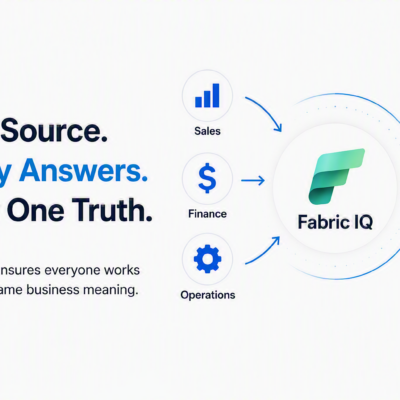
With Fabric IQ – Microsoft’s enterprise intelligence layer offering context and reasoning for data access – and the new Graph capability (now in Public Preview), Microsoft is turning Fabric into a more context-aware intelligence platform. This enables agents to provide decision-relevant responses, and Microsoft expects agents to soon become integral to the enterprise workforce. Fabric will serve as the data foundation for these agents, making organizational analytics investments smarter.
Database Hub – A Central Control Plane for the Entire Database Estate
The Database Hub was among the notable announcements at FabCon. Now available in early access, the Database Hub serves as an agentic control plane, offering organizations a unified view and comprehensive management layer across diverse database environments, including Azure SQL, Cosmos DB, PostgreSQL, SQL Server (via Azure Arc), MySQL, and Fabric databases, consolidating them within a single management interface. This solution enables centralized observability, delegated governance, and Copilot-powered insights spanning cloud, edge, and on-premises deployments. Agent-assisted functions proactively identify issues and recommend actions. This provides a simpler, more reliable method for managing databases at scale. Additionally, Microsoft unveiled a new Database Savings Plan, which offers potential cost savings of up to 35% compared to the pay-as-you-go pricing model.
Fabric Developer Tooling Updates
Fabric’s Model Context Protocol (MCP) received two important updates. The MCP is an open standard that links AI applications to external systems. Fabric Local MCP is now generally available, providing an open-source local server that allows AI coding assistants such as GitHub Copilot, Claude, and Cursor to connect securely and directly to Fabric. In addition, Fabric Remote MCP entered in public preview. This is a cloud-hosted, secure execution engine that lets AI agents and automation tools perform authenticated actions within Fabric. These enhancements boost productivity for data engineering and development teams and demonstrate how deeply Fabric is being integrated into the wider AI ecosystem. As a result, organizations planning a Microsoft Fabric implementation should include MCP readiness in their architectural strategies.
Expanding OneLake Interoperability
Interoperability was a central focus at the Microsoft Fabric FabCon 2026 Conference. Microsoft OneLake consolidates data from various sources (cloud, on-premises and third-party systems) into one analytics lake. Updates included mirroring for SharePoint lists and Dremio (public preview), Oracle and SAP Datasphere (general availability), plus new features like Change Data Feed and view creation (on top of mirrored data), starting with Snowflake. OneLake now natively integrates with Azure Databricks via Unity Catalog (public preview), alongside the general availability of interoperability with Snowflake (announced at Snowflake’s BUILD conference in February 2026). OneLake Security is scheduled for general availability in the near future, providing integrated role-based access control along with uniform row- and column-level security throughout all Fabric platforms. These improvements strengthen OneLake’s security and interoperability for modern data architecture.
Other Wave of Updates from FabCon 2026
Data engineering teams can now take advantage of Fabric Runtime 2.0 (in preview), which brings major platform upgrades for large-scale Spark workloads, including Apache Spark 4.0, Delta Lake 4.0, Scala 2.13, and Azure Linux Mariner 3.0. Delta Lake 4.0 brings improvements around performance, transaction handling, and table optimization, delivering faster reads and writes, better concurrency, and more efficient storage management.
Dataflow Gen2 now offers a Modern Query Evaluator with a .NET 8-based engine, enhancing performance and reliability in Power Query transformations. It also features Variable Library integration (generally available) for enterprise CI/CD and ALM workflows, helping teams standardize environment-specific values and deployment patterns.
What This Means to You?
These latest announcements from Microsoft reinforce a clear message: Microsoft Fabric is maturing into a more unified, intelligent, and enterprise-ready data platform that brings databases, analytics, governance, AI, and operations together under one governed system. The announcements from Microsoft Fabric FabCon 2026 show how early adopters can gain a competitive advantage in data management and value realization.
As a trusted Microsoft Partner, VNB Consulting helps organizations design and implement Fabric solutions, turning these innovations into real business results. Our team supports customers with Fabric deployments, agentic AI workflows, data migration, and governance strategies.
The main takeaway from FabCon 2026 is very clear: the future of enterprise data is unified, intelligent, and actionable today. To maximize these advancements, contact us today to book a Fabric strategy workshop.