From Manual Reporting to Real-Time Analytics: Modernizing Law Firm Analytics with Power BI

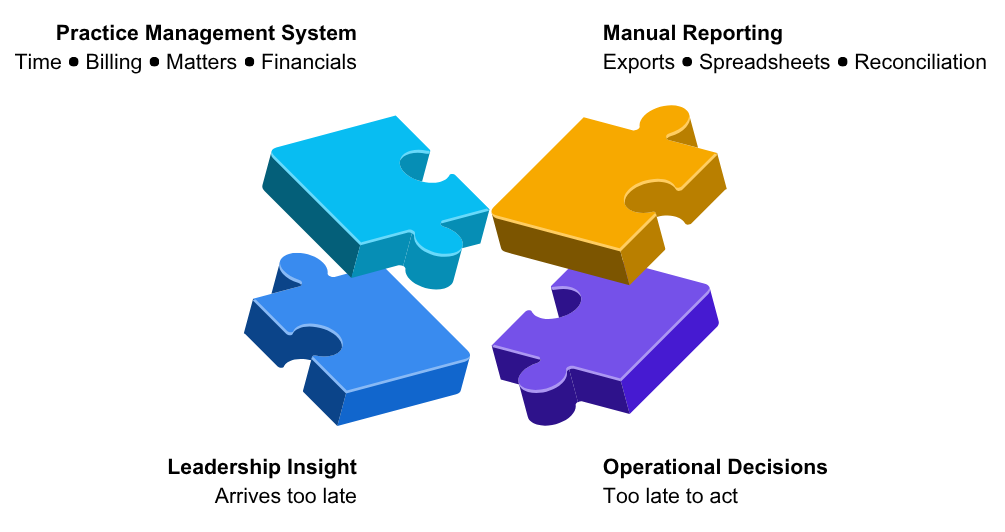
If you’re managing a law firm, your practice management system is already doing its job by capturing time entries, billing activity, matter details, and financial transactions every day. The data is there, but the challenge is what happens next – and this is where modern law firm analytics with Power BI becomes critical.
For many firms, turning that data into insights still relies on manual exports, spreadsheet reconciliations, and periodic reporting cycles instead of real-time visibility. By the time leadership has a clear view of revenue performance, accounts receivable (A/R) aging, or attorney utilization, the chance to take action has often passed. This isn’t a technology problem; it’s an analytics gap.
The Hidden Cost of Manual Reporting
Law firms depend on facts. Evidence, documentation, and verifiable records shape everything they do for clients. Internally, however, critical business decisions often rely on reports that are manually created, isolated across teams, and outdated by the time they’re reviewed.
Manual reporting rarely fails in obvious ways. Data gets pulled, spreadsheets get updated, and reports reach stakeholders. The cost shows up in other areas: delayed insights, reconciliation efforts, and decisions made without current context. As firms grow, these gaps become more visible:
- Revenue leakage identified too late: Limited visibility into billing realization rates and write-offs makes early intervention hard.
- A/R aging that quietly worsens: When receivables data is in spreadsheet exports, aging buckets lag days or weeks behind. Clients often slip past 60, 90, and 120 days before anyone notices.
- Utilization blind spots: Without a centralized view of billable versus non-billable hours, balancing workloads becomes inconsistent, and underperformance goes unnoticed.
- Delayed indicators limit responsiveness: Monthly reporting cycles limit quick responses. Staffing, pricing, and client management decisions need real-time data.
- Inconsistent numbers across teams: When billing, finance, and operations pull their own exports, reconciliation becomes a regular effort.
- Reporting that doesn’t scale: Spreadsheet-based workflows become tougher to maintain as firms grow.
In all these cases, the pattern is the same: the data is there, but insights come too late to act on them.
The Paradigm Shift: From Reporting to Decision Support
Reporting and decision support have different goals. Reporting shows what happened. Decision support provides current information while decisions can still affect outcomes.
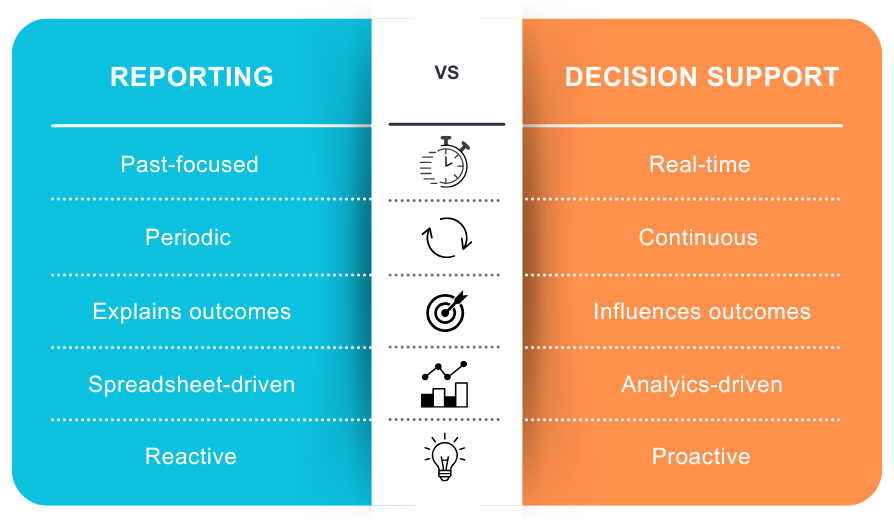
This is the shift that modern analytics enables for law firms, moving away from a cycle of export, reconcile, and review. It creates an environment where information is timely, accessible, and actionable. That’s what differentiates firms that actively use their data from firms that simply accumulate it.
One Layer Changes Everything
Whether your firm runs on Clio, TimeSolv, SurePoint, Elite, LexisNexis Juris, Elite 3E, or any other PMS, the data needed for analytics is already in place. What’s missing is the layer that connects it to the decisions your leadership team must make.
Microsoft Fabric provides a comprehensive analytics platform for organizations with complex, multi‑source data environments. But not every firm needs the full Fabric stack to unlock meaningful insights.
For small to mid‑sized law firms with only a few data sources, Power BI alone can be a perfect fit. It delivers powerful analytics capabilities without requiring a full system overhaul, making it ideal for firms that want actionable insights quickly and cost‑effectively.
As firms grow and their data landscape becomes more complex, Power BI can seamlessly extend into Fabric, ensuring scalability without disruption.
From One-Off Analytics to a Repeatable Approach
Many assume analytics projects are always bespoke: built from scratch, unique to each firm, and impossible to replicate. In reality, while every organization has its own systems and priorities, the underlying data challenges are remarkably similar. Delivering consistent value from law firm analytics with Power BI requires a structured, repeatable approach. That’s why VNB combines a proven methodology with deep domain expertise across law firm operations and data. Here’s how we put it into practice:
Step 1: Discovery: Decisions Drive Design
We begin by working with stakeholders to understand the decisions they need to make and the information gaps holding them back. Instead of jumping straight into dashboards or queries, we first map the PMS data structure to identify where relevant data lives and what preparation is required. The outcome: a clear project plan detailing what we’ll build, for whom, and why.
Step 2: Building a Reliable Data Foundation
Next, we connect to your PMS data layer—whether via direct database connection, API, or automated export—and construct a clean, trusted data model in Power BI. This includes standardizing formats, improving data quality, and defining relationships across matters, timekeepers, clients, invoices, and payments. A solid foundation builds trust in the dashboards, and trust fuels adoption.
Step 3: Delivering Actionable Insights
Finally, we design Power BI dashboards aligned with your firm’s KPIs and leadership priorities. Usability is as important as functionality, so we review dashboards with your team before launch to ensure they reflect your business perspective. The result is not just a set of reports, but a scalable analytics framework that grows with your firm.
Real-World Example: Turning PMS Data into Firmwide Intelligence
VNB recently partnered with a national law firm grappling with familiar challenges. Although their PMS reliably captured data each day, extracting meaningful insights demanded heavy manual effort. Leadership lacked centralized dashboards, and reporting processes struggled to keep pace with the firm’s expanding operational needs.
The objective was clear: create an analytics layer that unified financial and operational data into a consistent view of firm performance, without replacing their existing PMS, LexisNexis Juris.
Our Approach
VNB connected Power BI directly to the firm’s PMS data layer, built an automated integration to eliminate manual data pulls, and delivered dashboards across five critical KPI domains:
- Financial & Revenue Performance: Real‑time visibility into billed and collected fees (MTD, YTD, prior year), billing realization rates, write‑offs, and revenue trends.
- Billing & Productivity Analytics: Centralized tracking of billable vs. non-billable hours and attorney productivity trends, uncovering patterns previously hidden.
- Operational Efficiency & Utilization: Insights into resource utilization, billing rates, and firm-wide activity, enabling stronger oversight and efficiency.
- A/R & Collections Visibility: Real-time receivables and aging bucket metrics, empowering proactive collections management.
- Advanced Performance Intelligence: Early identification of client and practice-area trends, revenue risks, and underperforming matters before they escalate.
The firm gained a scalable analytics framework that transformed raw PMS data into actionable intelligence. Leadership now has a single source of truth for performance, enabling faster decisions, improved oversight, and a foundation for continued growth.

While Power BI enables this shift to real-time insights, many firms still face challenges in integrating data from their internal systems (such as Juris) and establishing a consistent analytics foundation. To address this, solutions like our Microsoft Fabric Accelerator for Juris provide a structured approach to centralizing data, standardizing reporting, and delivering real-time visibility across financial and operational metrics.
The Next Step – Building on What You Already Have
The data in your practice management system is already sufficient for meaningful analytics. You don’t need a new system or a lengthy overhaul. You need the right layer on top of what you already have, built correctly.
At VNB Consulting, we help law firms modernize analytics by building on existing systems, instead of replacing them. By aligning financial, billing, utilization, and collections data, we help law firms move beyond manual reporting and turn existing data into an operating capability.
If your firm is ready to see what this looks like in practice, the next step is to understand how data supports decisions today, and what changes when insights come early to affect outcomes. Let’s talk.