Analytics Isn’t a Product — It’s a Launchpad: Why Enterprise Value Starts with Actionable Insight

In recent years, conversations around enterprise data strategy have increasingly centered on dashboards, KPIs, and visualization platforms. Organizations invest heavily in analytics platforms expecting that better reporting will naturally translate into better outcomes.
But analytics was never meant to be the destination. It is the starting point.
The real value of analytics does not lie in the ability to display information. It lies in the ability to influence decisions and trigger actions inside the systems and processes where real work happens.
The Dashboard Illusion
Across industries, many organizations still treat analytics as the final layer of their technology stack. Dashboards are built, reports are shared, and insights are reviewed during periodic meetings.
But a dashboard by itself rarely changes business outcomes.
A dashboard is a mirror. It reflects what has already happened. A predictive model is a hypothesis about what might happen next. The real enterprise value emerges only when insights influence operational workflows.
When insights remain confined to dashboards, organizations gain visibility but not transformation.
The Shift Toward Actionable Analytics
Forward-looking organizations are beginning to rethink how analytics should function within the enterprise. The goal is no longer simply to analyze the business. The goal is to enable the business to act.
Three major trends are driving this shift.
First, unified data platforms and modern Lakehouse architectures are dramatically reducing the time it takes to transform raw data into insights.
Second, predictive analytics and AI models are becoming increasingly common. However, many of these models remain disconnected from operational systems where decisions are made.
Third, organizations that are seeing measurable ROI are those that operationalize insights by connecting analytics directly to applications and automation.
From Insight to Action: The 4A Enterprise Model
At VNB Consulting, we describe modern enterprise transformation using four connected capabilities:
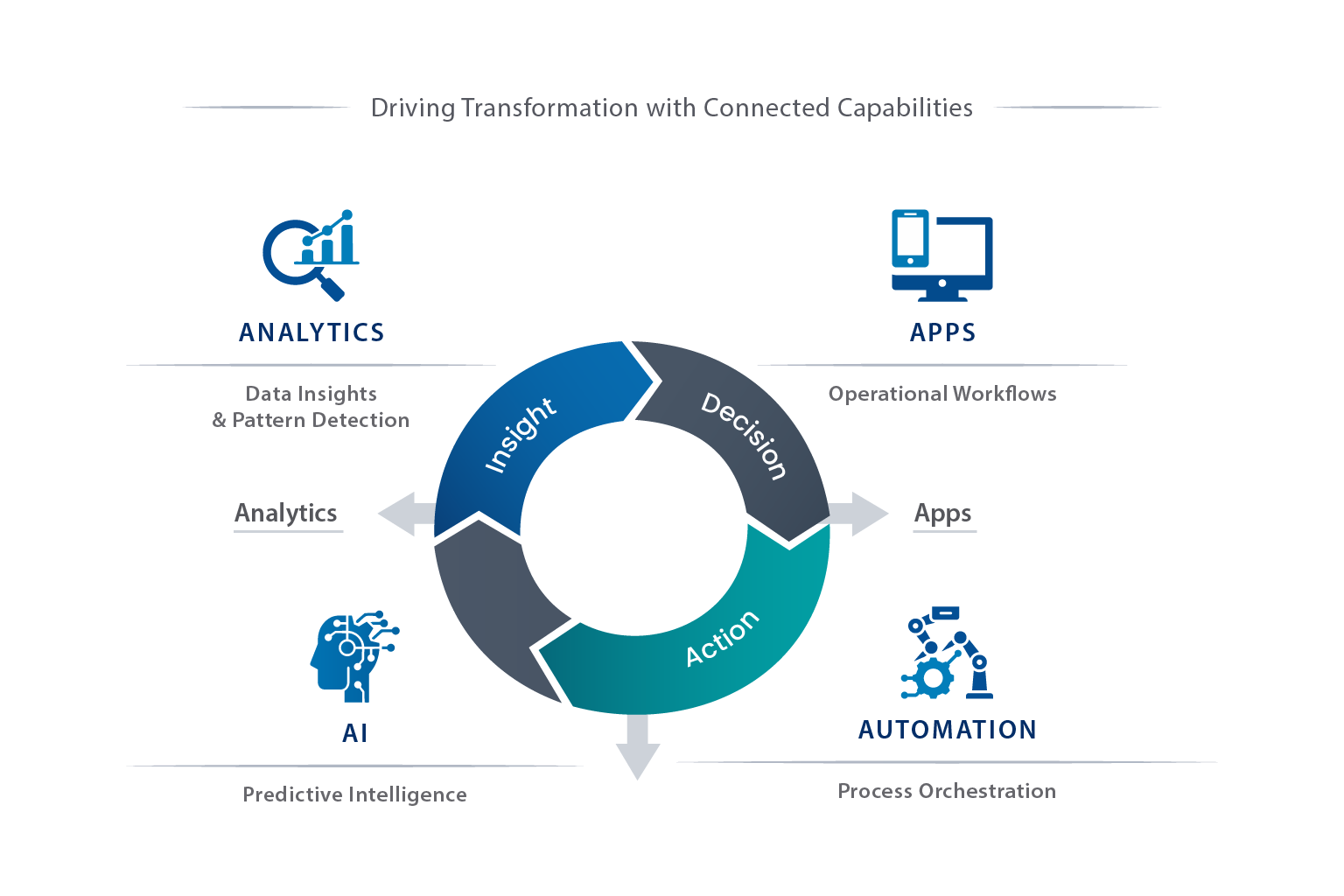
Analytics generates insights and detects patterns within enterprise data.
Applications embed those insights into operational workflows where employees interact with systems.
Artificial intelligence augments human decision-making by predicting outcomes and identifying opportunities.
Automation executes or orchestrates actions across systems and processes.
When these four capabilities are connected, organizations create a closed loop between insight, decision, and execution.
What True Data Transformation Looks Like
Organizations that successfully operationalize analytics typically achieve several outcomes.
Analytics systems detect anomalies, risks, or opportunities automatically.
Insights surface directly inside the applications that employees use every day.
AI models assist in evaluating potential decisions or recommending optimal actions.
Automation frameworks execute workflows or trigger processes without requiring manual intervention.
In this model, analytics is no longer passive reporting. It becomes an active component of enterprise operations.
Measuring the Real Value of Analytics
For technology leaders, the success of analytics initiatives should not be measured by dashboard adoption alone.
Instead, the most meaningful indicators of success include:
- Reduced process cycle times
- Fewer manual touchpoints across workflows
- Faster and more consistent decision-making
- Measurable improvements in operational KPIs
If analytics initiatives are not influencing operational processes, the transformation journey is still incomplete.
Rethinking the Role of Analytics
The next phase of enterprise data strategy will focus less on reporting and more on operational intelligence.
Analytics will increasingly function as the catalyst that drives automated, AI-assisted, and application-integrated decision making.
In other words, analytics will evolve from a reporting layer into a launchpad for enterprise action.
Looking Ahead
As organizations continue to invest in modern data platforms and AI capabilities, the competitive advantage will come from those who can connect insights directly to execution.
Technology leaders who rethink analytics as part of a broader architecture — connecting analytics, applications, artificial intelligence, and automation — will unlock far greater value from their data investments.
The question every CIO and CTO should be asking is simple: Where does this insight change a process?
Because insight that never influences action is simply information. Insight that changes how work happens is transformation.
Ready to transform the impact of analytics in your organization?
Contact us to learn how we can help you build a data and analytics strategy that drives real operational changes.
** Content Credits: DPS Bali