Azure Data Factory to Microsoft Fabric: A Smarter Path to Data Integration
For years, Azure Data Factory has been a core service for orchestrating data movement across Azure. Its pipelines often support business-critical processes, so any change to the integration estate demands careful planning. Fabric Data Factory places data integration within Microsoft Fabric, alongside OneLake, data engineering, warehousing and reporting. For organizations planning an Azure Data Factory to Microsoft Fabric migration, the question is not simply whether existing pipelines can move, but whether they support the architecture the business needs next.
That question should guide the migration from the outset. Rather than recreating the entire Data Factory estate in Fabric, organizations should determine the right future for each workload.
Why Consider Moving to Fabric Data Factory?
Azure Data Factory continues to serve its purpose. The stronger case for Fabric Data Factory lies in how closely it connects integration with the wider data platform.
In many established Azure environments, integration, storage, transformation and reporting often span separately managed services. Each boundary adds connections to maintain, controls to coordinate and failures to trace. Fabric Data Factory brings integration closer to OneLake, Lakehouse, Warehouse and the reporting workloads that rely on them.
OneLake also changes the role of the pipeline. Rather than repeatedly copying data between analytical services, organizations can design integration around a common data foundation shared by engineering, warehousing and reporting workloads. Data movement does not disappear, but avoidable copies can.
The business case is not a better pipeline interface, but a more direct and manageable path from source data to trusted insight. For organizations already adopting Fabric, keeping integration outside the platform may preserve the fragmentation that modernization is meant to eliminate.
Move, Redesign or Retain?
The question is not whether to migrate Azure Data Factory to Microsoft Fabric in its entirety, but which path best suits each workload. Business value, dependencies, architectural fit and operational risk differ across the estate, and applying one approach to every pipeline either preserves unnecessary complexity or creates redesign work where little is needed. The migration roadmap should classify each workload as move, redesign or retain.
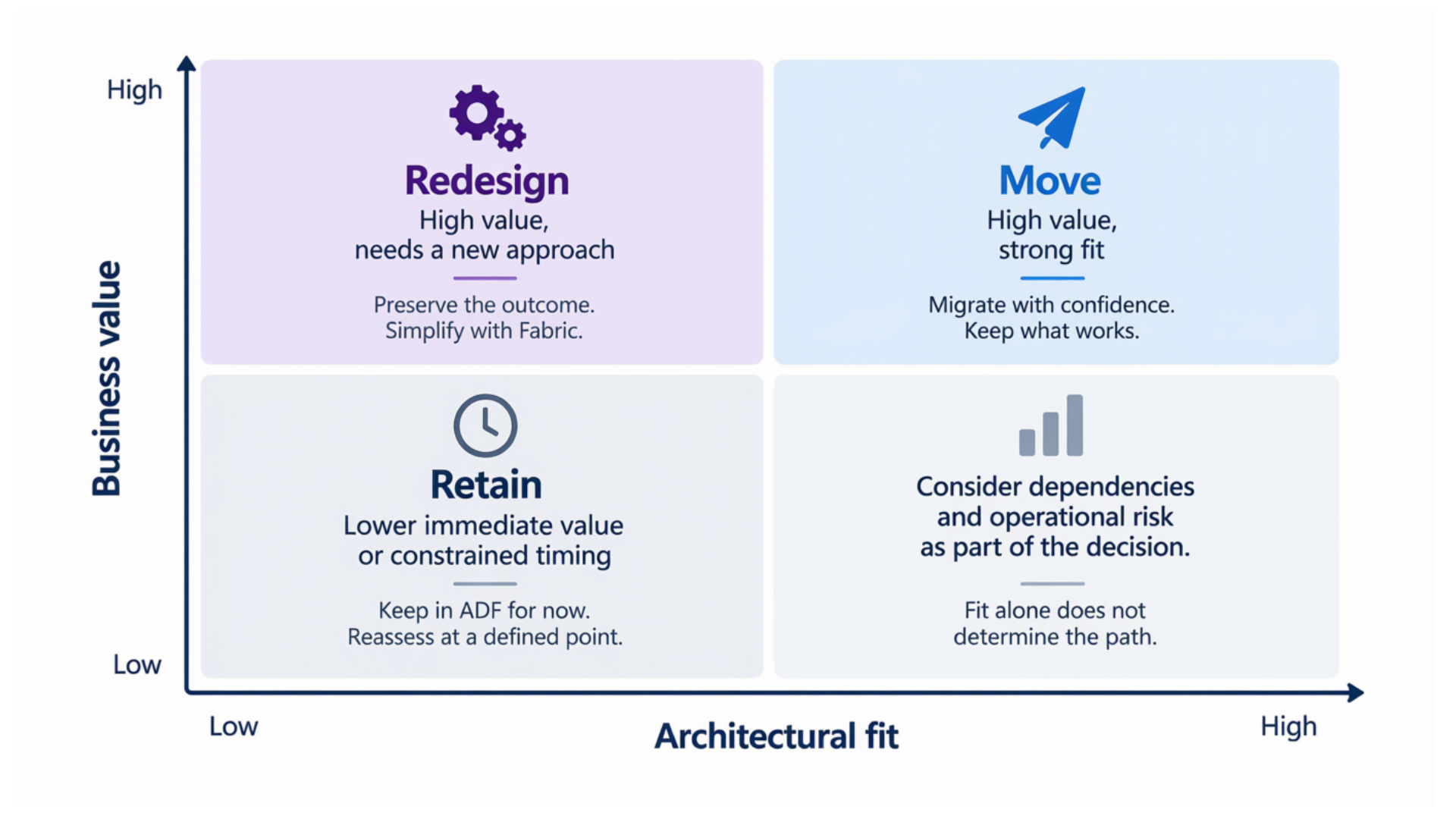
Move stable pipelines that still support a valuable business process, have understood dependencies and fit the target Fabric architecture without significant rework.
Redesign workloads where duplicated transformations, unnecessary data movement or orchestration patterns reflect the constraints of the previous architecture. Preserve the business outcome while simplifying how it is delivered. This may include replacing ad hoc staging copies with a Bronze, Silver, and Gold structure, where raw, standardized and business-ready data are managed as deliberate layers of the Fabric architecture.
Retain pipelines in Azure Data Factory when compatibility gaps, operational risk or business timing make an immediate move impractical. Coexistence can be a deliberate stage while the organization validates Fabric and builds operational confidence.
Where Migrations Go Wrong
The move, redesign or retain framework only works if the assumptions beneath it hold. ADF to Fabric migration plans built on untested assumptions uncover hidden dependencies, pull unnecessary workloads into scope or leave the organization without a model for running Fabric.
Mistaking Familiarity for a Simple Migration
Fabric Data Factory may feel familiar to teams experienced with Azure Data Factory, but familiarity is not equivalence. When timelines are set before dependencies and target-state requirements are validated, differences surface later as unplanned redesign, testing and cutover work. Architecture validation should shape the schedule, not follow it.
Migrating before rationalizing
A mature pipeline estate reflects years of changing requirements, temporary fixes and shifting ownership. Some pipelines may be essential while others may be duplicated, inactive or no longer needed. Assessing each one first keeps outdated logic from carrying forward and turns the backlog from an inventory of what exists into a plan for what the organization still needs.
Treating migration as a project, not a platform shift
A cutover plan explains how workloads move, not how the new environment will be owned, governed and expanded. Capacity sizing and ownership, workspace standards, skills and operational responsibilities need clear decisions before cutover, particularly because Fabric workloads share capacity. Reusing pipelines and data assets does not mean low migration effort: monitoring, deployment, testing and operational readiness may still need substantial new work. Without that planning, the organization may reach Fabric without a sustainable model for running it.
Turning the Framework into a Fabric Data Factory Migration Roadmap
Once each workload has a direction, the focus turns to sequencing. Classification decides what happens to a pipeline; the roadmap decides when. A pipeline marked for move is not automatically the right place to start, and the one marked as redesign need not hold up the wider transition.
Begin with workloads that have clear business value, well-understood dependencies and manageable cutover risk. These early moves let teams test deployment, monitoring and support before taking on business-critical pipelines. Redesign work can run on a separate track, and retained pipelines should have a defined review point so coexistence does not become permanent by default.
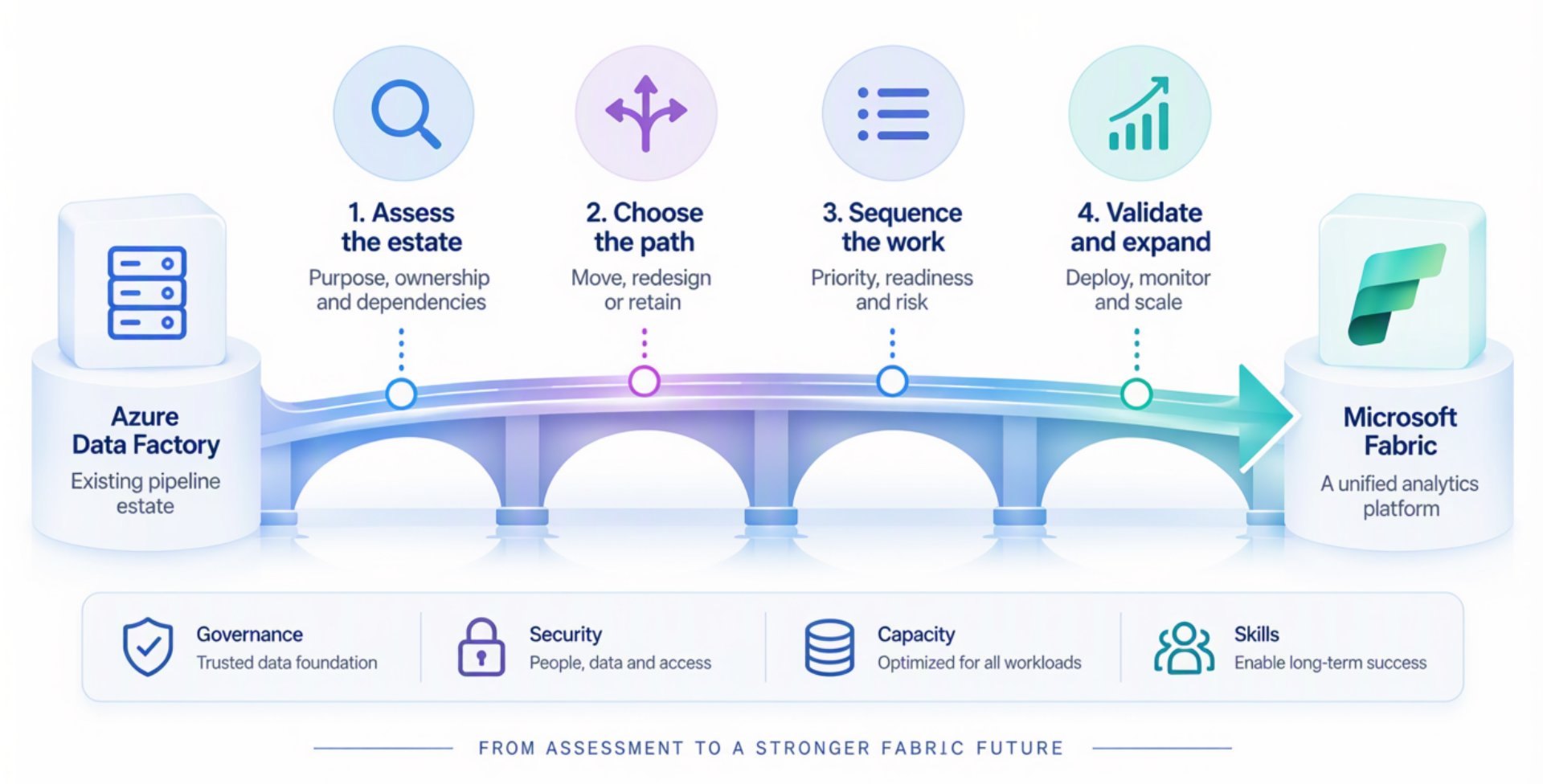
Microsoft’s built-in Migration Assistant is a useful technical starting point for Fabric Data Factory migration. Its compatibility assessment shows which pipelines are ready, which need closer review and which require a different approach. The guided experience suits compatible pipelines, while more complex estates may still require scripted migration or manual redesign, so the roadmap should allow these approaches to run in parallel.
What a Successful Transition Should Deliver
An Azure Data Factory to Microsoft Fabric migration should not be judged by how quickly pipelines are recreated or how many workloads reach Fabric. The stronger measure is what becomes simpler afterward.
Some pipelines will move with little change, others will require redesign, and some will stay in Azure Data Factory until the timing is right. Each decision should reduce unnecessary complexity and support the intended Fabric architecture.
The resulting integration estate should contain fewer duplicated patterns, staging layers and legacy dependencies. Pipelines should be easier to monitor and support, with trusted data reaching reporting, analytics and AI through a more manageable operating model. Migration ends when the workloads have moved. Azure Data Factory modernization succeeds when the integration estate becomes easier to operate, govern and extend.
VNB Consulting helps organizations assess their Azure Data Factory estate, classify each workload and build a governed Fabric roadmap using reusable delivery patterns. To discuss where your estate stands, get in touch for a Fabric migration assessment.