Why Unified Data Is No Longer Enough: The Rise of Business-Aware Intelligence Platforms
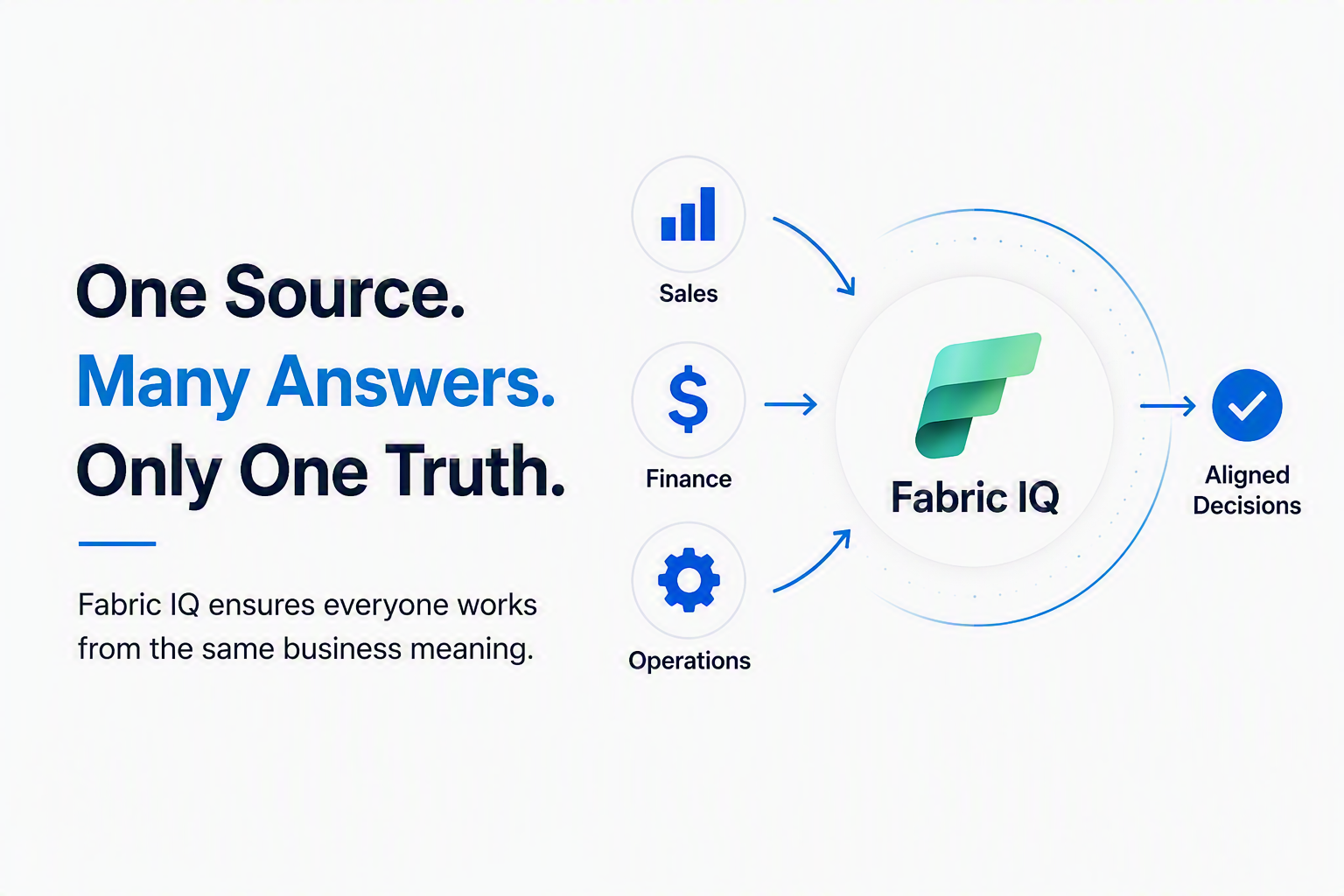
Microsoft Fabric IQ comes at a time when many organizations realize that simply unifying data is not enough.
For years, organizations have focused on bringing data into warehouses, dashboards, and analytics platforms. While this has improved access and reporting, it has not solved the bigger challenge: making sure teams understand and interpret data the same way.
Many organizations now have more data, better pipelines, and stronger reporting. But as AI becomes part of analytics and decision-making, consistent business context becomes even more important. AI is only reliable when it works from approved definitions, trusted logic, and a clear understanding of how the business measures performance.
This is where data strategy is changing. The future is not just about unifying data, but about unifying business meaning.
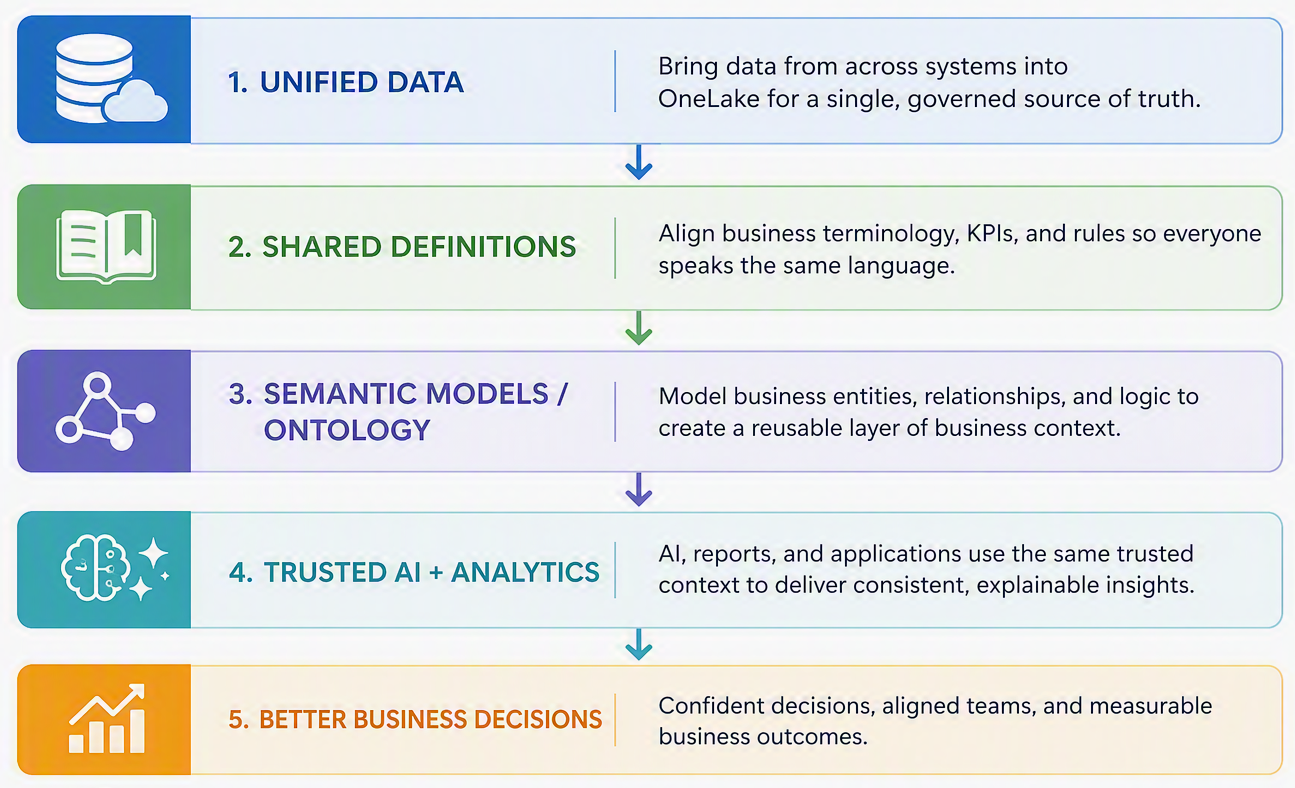
Organizations need platforms that do more than store and process information. They need platforms that help people, applications, and AI systems work from a shared business foundation.
What Microsoft Fabric IQ Means for Business-Aware Intelligence
In simple terms, Microsoft Fabric IQ helps connect enterprise data with the business concepts, definitions, relationships, and semantic models that give that data meaning. The goal is not to add another AI feature to the data stack. It is to help dashboards, reports, AI tools, and business workflows operate from a more consistent understanding of enterprise data.
Why this matters: Trust in analytics does not come only from having data in one place. It comes from knowing that the definitions, relationships, and logic behind that data are consistent wherever they are used.
Why Unified Data Alone Is No Longer Enough
A modern data platform can bring information from many systems into one environment. But business teams may still define the same question differently.
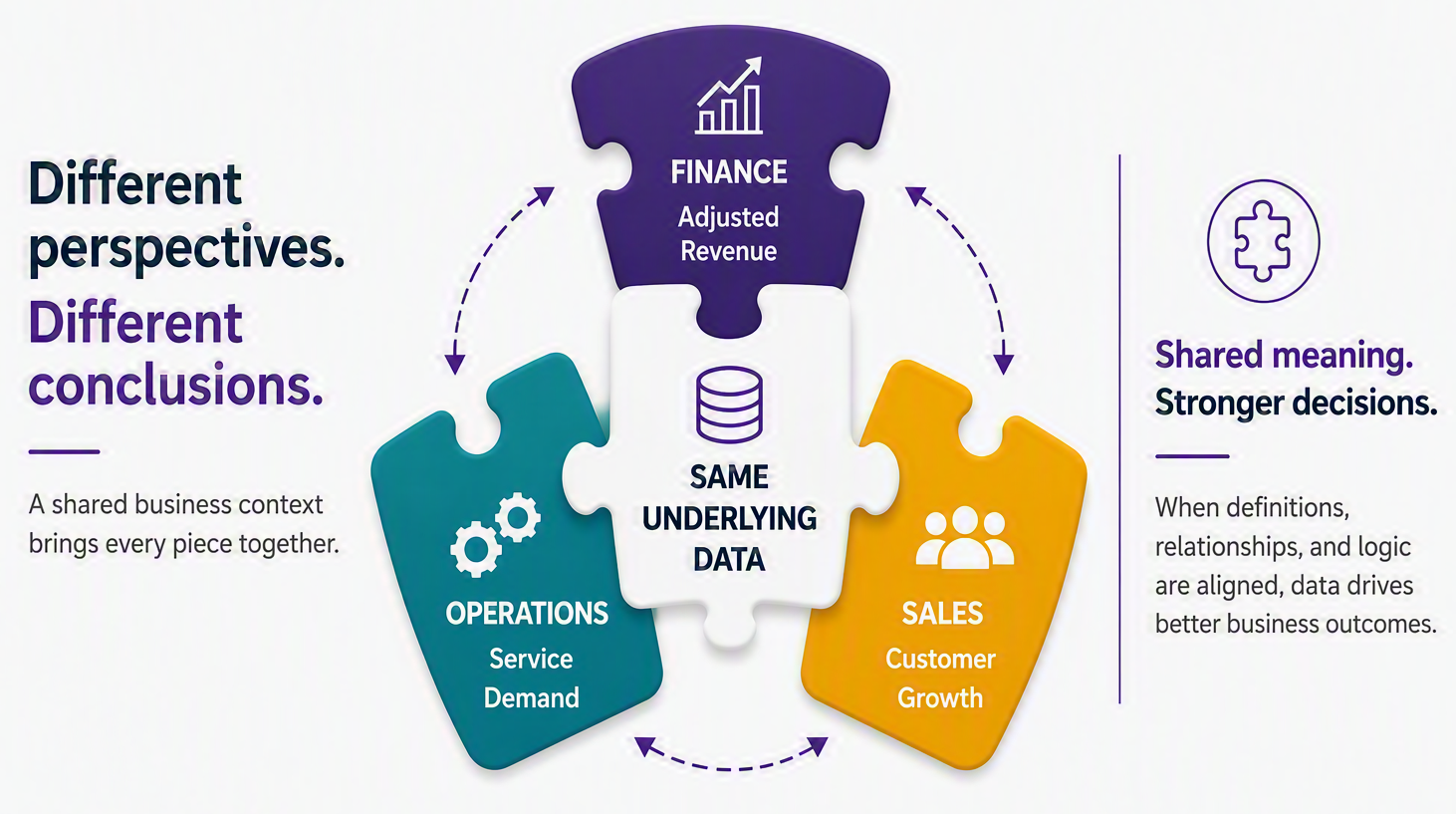
One team may define an “active customer” by recent transactions, while another may use account status. Finance may calculate revenue with adjustments, while operations may use a different version of the same metric. Each report may look accurate on its own, but decision-making becomes difficult when the underlying meaning is not aligned.
In healthcare, this becomes even more visible. Terms such as claim denial, clean claim, patient access, or net collection rate need consistent interpretation across revenue cycle, finance, operations, and analytics teams. If each function applies its own logic, reports may create confusion even when the data itself is centralized.
AI increases the urgency of this issue. AI-assisted analytics can make questions easier to ask and answers faster to generate. But those answers are useful only when they reflect how the organization defines customers, claims, revenue, risk, performance, or outcomes.
That is why the next phase of data maturity must go beyond unified data platforms. It requires a shared business foundation where data, definitions, relationships, and decision logic work together.
Questions That Reveal Whether Your Data Platform Is Business-Aware
Once data is centralized, the next question is simple: can the business trust the meaning behind it?
A few practical questions can help leaders understand whether their platform is simply making information available, or whether it is helping the business make better decisions.
Are teams interpreting the same data in the same way?
A leadership team may look at customer performance and see different views from sales, finance, and operations. Sales may see growth, finance may see flat revenue, and operations may see rising service demand. Each team may be right, but they may also be using a different definition, filter, or calculation.
This is where shared business meaning becomes important. In the context of Microsoft Fabric IQ, semantic models, business entities, and common context can help connect these different views to a more trusted foundation.
Can AI use trusted business logic?
AI can answer questions quickly, but speed alone is not enough. If a user asks, “which customer segment had the highest revenue growth”, the answer should use the right revenue definition, customer segmentation logic, access rules, and governed measures.
Microsoft Fabric IQ can help connect AI-assisted experiences with semantic models, business definitions, and governed context so responses align more closely with how the organization actually measures performance.
Can teams understand what is influencing business outcomes?
Dashboards often show what happened: revenue changed, claims increased, inventory slowed, or customer engagement dropped. But business leaders usually want to know what influenced that change.
That answer depends on connected business context. A revenue trend may relate to region, product mix, pricing, or customer segment. A healthcare denial trend may relate to authorization, coding, payer behavior, or process delays. Business-aware intelligence helps connect these signals so teams can understand the context behind performance changes.
How Business-Aware Intelligence Applies Across Industries
The need for shared context is not limited to one industry. It shows up wherever teams depend on data to make faster, more confident decisions.
In healthcare, claim denial, clean claim, patient access, and net collection rate need consistent interpretation across revenue cycle, finance, operations, and analytics teams.
In retail, inventory, promotions, loyalty, fulfillment, and customer behavior often sit across different systems. The value comes from understanding how these signals connect, not just viewing them separately.
In manufacturing, asset performance, supplier quality, downtime, maintenance, and delivery commitments are closely related. When these concepts are connected, teams can move from isolated operational metrics to clearer insight into business impact.
Across industries, the pattern is similar: data becomes more useful when teams can interpret it through shared definitions, relationships, and context.
Where Organizations Should Begin
Organizations do not need to transform every data asset, dashboard, or AI use case at once.
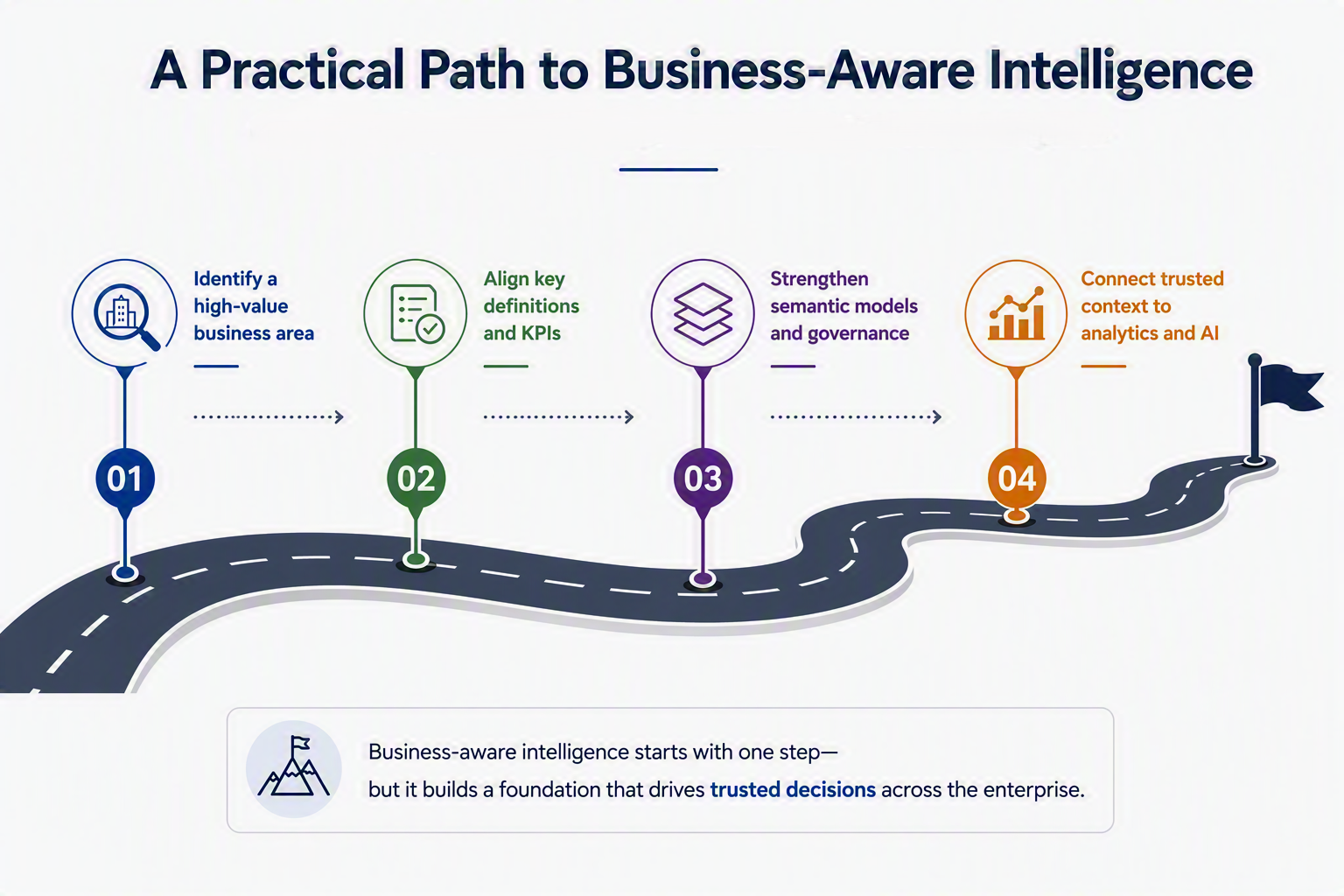
A practical starting point is to identify one high-value business area where definitions are inconsistent, reporting logic is duplicated, or teams frequently debate the meaning behind the numbers. The goal is to start where a common business language can create visible impact.
From there, organizations can strengthen the foundation: align key business definitions, improve semantic models, apply governance, and connect trusted logic to analytics and AI-assisted experiences.
The journey should begin with meaning, not the tool. When the right definitions, relationships, and governance are in place, AI and analytics can become more trusted, scalable, and useful for business decision-making.
How VNB Consulting Can Help
Moving toward business-aware intelligence requires more than adopting a new platform capability. Organizations need to identify where business definitions are inconsistent, where reporting logic is duplicated, and where AI use cases require stronger semantic and governance foundations.
VNB Consulting helps organizations modernize data, analytics, and AI foundations on Microsoft Fabric by connecting strategic priorities with practical implementation. This includes assessing current data and reporting landscapes, strengthening semantic models, aligning business definitions, improving governance readiness, and identifying high-value use cases where trusted intelligence can create measurable business impact.
For organizations exploring Microsoft Fabric IQ, the opportunity is to think beyond individual dashboards or AI experiments. The bigger goal is to build a data foundation where business meaning, analytics, and AI-assisted decision-making can work together with greater consistency and trust.
Wrapping Up
Trusted intelligence does not begin with AI alone. It begins with clear definitions, governed context, strong semantic models, and a shared understanding of how the business measures performance.
That is why Microsoft Fabric IQ is important in the broader evolution of Microsoft Fabric. It reflects a shift from simply unifying data to making business meaning more connected, reusable, and accessible across analytics, AI-assisted experiences, and decision-making workflows.
The future of data platforms will be shaped by how well they help organizations move from information access to business understanding. That is where business-aware intelligence becomes the next meaningful step in enterprise data maturity.